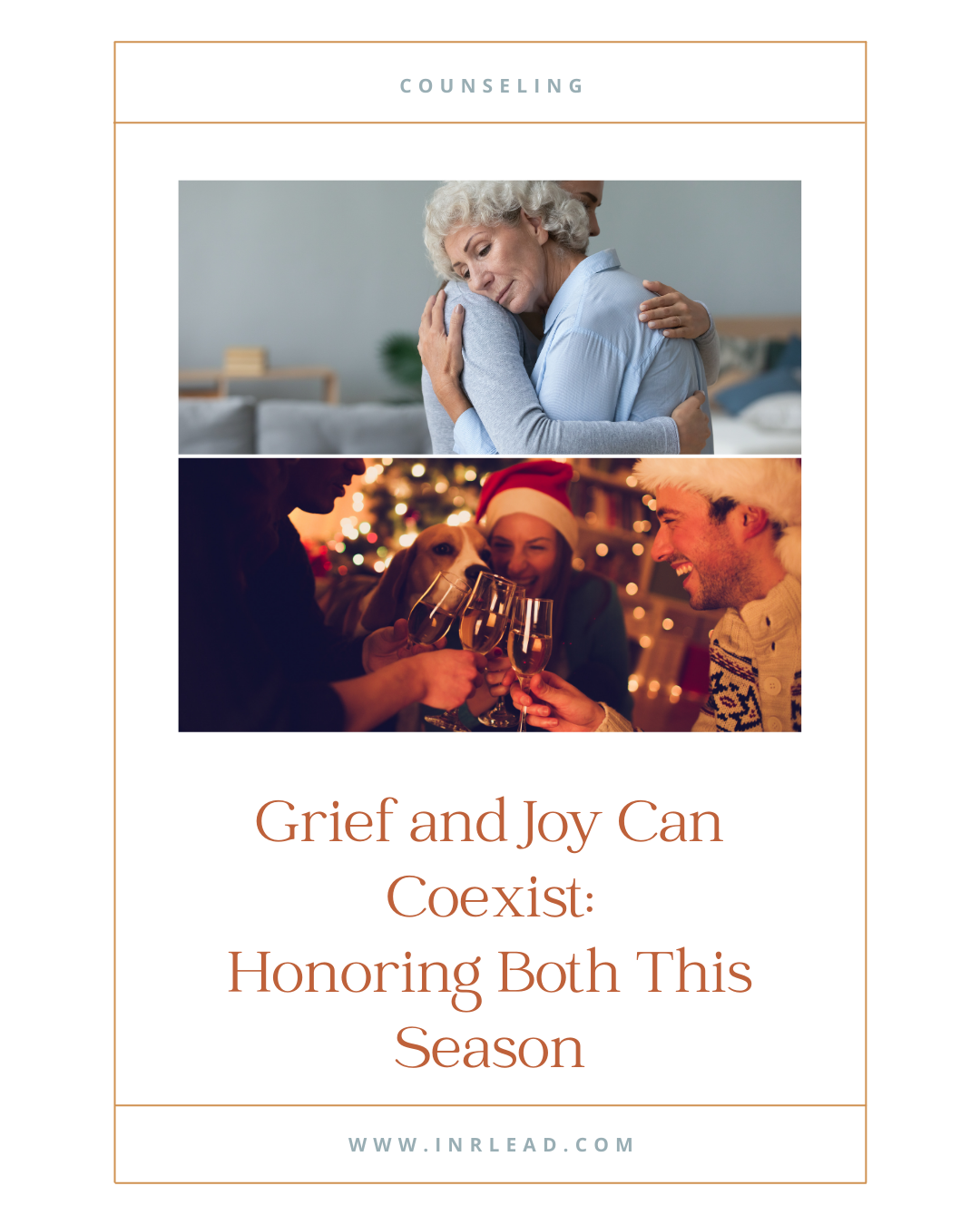
Grief and Joy Can Coexist: Honoring Both This Season
When the holidays hold contradictions, your capacity to hold both is not a failing
You're sitting at the dinner table. Someone says something funny and you laugh. Your chest feels warm. And then, in the same breath, you remember: this is the second holiday without the person who used to sit in that chair. The laughter doesn't disappear. But it sits next to an ache. Both things are true at the same time.
Or maybe your grief isn't about someone who died. Maybe it's about who you were before everything changed. Or the family you imagined having. Or the way things could have been if circumstances had been different. Maybe it's all of it at once.
There's a narrative that tells us the holidays should be purely joyful. That grief has no place there. That if you're sad, you're doing it wrong. That you should either mourn privately in some other season or set your grief aside in service of the collective celebration.
This is not just wrong. It's cruel. And it's impossible to actually do without fragmenting yourself.
The Both/And That the Holidays Won't Teach You
Grief and joy aren't opposites. They're not even inverse quantities, where you have to choose how much of each one gets to be present. They coexist. And the holidays—paradoxically, despite all the pressure toward relentless joy—are actually a place where this coexistence becomes most visible.
The fact that you can feel both—that you can laugh and hurt, that you can appreciate the people at the table while missing someone who isn't there, that you can feel grateful for what you have while grieving what you've lost or never had—this isn't evidence that something is wrong with you. It's evidence that you're actually present to the complexity of being alive.
But there's a cost to trying to suppress one in favor of the other. When you force yourself to be only joyful—to smile through the grief, to keep the conversation light, to move past the loss—something in your body knows you're not being authentic. Your nervous system can feel the effort it takes to hold that mask. You become exhausted without knowing why. Or the grief leaks out sideways: as irritability, as numbness, as a sense of disconnection from the people who are actually present.
Conversely, if you go the other direction—if you insist on center-staging your grief and apologize for it constantly, if you treat the holidays as primarily an occasion for loss—you're also fragmenting yourself. You're denying that joy exists alongside the pain. And that denial has its own isolation.
The capacity to hold both simultaneously? That's actually wholeness. That's presence. That's the mature response to a reality that isn't simple.
What It Looks Like to Honor Both
Honoring grief and joy doesn't mean treating them equally at every moment. It means acknowledging that both are real, and creating space for each one to exist in your experience.
Create intentional moments for grief
This might look like: lighting a candle before the meal and saying the person's name. It might look like visiting the cemetery before the gathering. It might look like writing a letter you never send. It might look like stepping outside alone for five minutes to cry, and then coming back in. It might look like telling someone you trust, "This is hard because..." and letting them know what you're carrying.
The point isn't to make the holiday "about" the grief. It's to make space so the grief isn't silently demanding your attention while you're trying to be present to joy. When grief has a place to exist, it's less likely to leak out sideways. It's less likely to consume everything.
Let joy exist even in small amounts
You don't need the full, elaborate narrative of joy that the culture is trying to sell you. You don't need to be glowing and grateful and present in the way the Hallmark version looks like. You just need to notice: what actually brings you a moment of lightness right now? What makes you smile even a little bit? It might be a conversation. It might be a food you love. It might be five minutes of quiet or a walk outside or the way the light comes through the window.
These small moments of joy aren't a betrayal of your grief. They're permission to be alive in a way that honors the full spectrum of what's real. You can mourn someone and still enjoy food. You can grieve a version of your family that never materialized and still appreciate the people who showed up. You can feel loss and still feel grateful. These things go together.
Name it when both are present at once
Sometimes the both/and is so present that you can actually articulate it. "I'm really glad you're here, and I miss [person]." "This is hard, and I'm glad we're together." "I'm having a good moment and also this season is heavier this year." Naming it doesn't make it go away, but it does something important: it lets the people around you know that you're not trying to be perfect, and it gives them permission to not try either.
Notice when one needs more space
Some years, the grief will be heavier. You might need more quiet moments. You might need to opt out of certain traditions. You might need to leave earlier or show up later. That's not a failure. That's you listening to what you actually need rather than what you're supposed to need. Some years, the joy will be easier to access. Let it. Both are legitimate. Both are part of what it means to live as a full person rather than a performing version of yourself.
What Changes When You Stop Choosing
When you stop trying to choose between grief and joy—when you stop thinking you need to suppress one to access the other—something shifts internally. You become less fragmented. You're less exhausted because you're not simultaneously processing two opposite narratives.
The grief doesn't become less painful. But it becomes less isolating. It becomes something you can carry and still be present to other people. You can be with your grief and with joy at the same time. Your body knows how to do this. You just have to give yourself permission to let it.
There's something sacred about this capacity—to hold pain and beauty in the same moment. It's not a failure to be overcome. It's actually the deepest form of presence available to us.
An Invitation
This holiday season, you're invited to stop trying to be purely joyful. You're invited to stop apologizing for your grief. You're invited to let both be real in your experience, and to trust that your capacity to hold both simultaneously is not a burden—it's your humanity showing up.
The people around you who matter will recognize this. And they'll stop trying to force you into a single emotional narrative. They'll see you. And maybe, seeing you, they'll give themselves permission to be whole too.
--- What would it look like to create one intentional moment for your grief this season? And what small moment of joy could you actually let yourself notice?