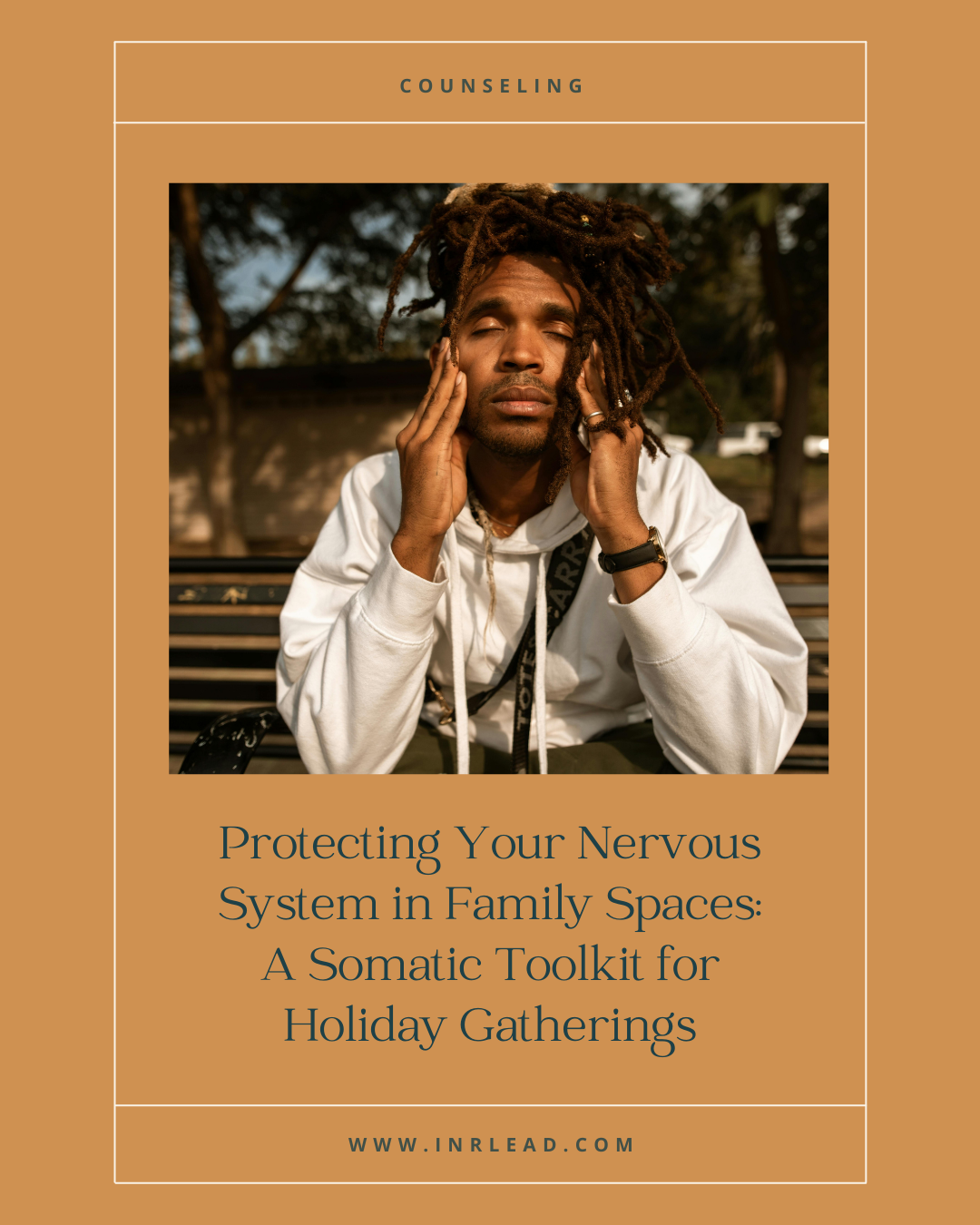
Protecting Your Nervous System in Family Spaces: A Somatic Toolkit for Holiday Gatherings
When family dynamics trigger your body, here's how to stay anchored
You walk into the kitchen where your family is gathered. Nothing dramatic happens immediately. Someone makes a comment about your life choices, or doesn't—it doesn't matter. Your chest tightens. Your shoulders creep toward your ears. You can feel yourself getting smaller, preparing to disappear. Or the opposite: you feel heat rising, an impulse to defend or leave or shut down the conversation entirely.
Your body is doing exactly what it was trained to do. Somewhere in your history—whether it was overt conflict, chronic tension, feeling unseen, being held to impossible standards, or something else entirely—your nervous system learned that family spaces aren't safe. It learned to protect you by going into defense mode.
This response isn't a character flaw. It's not evidence that you're too sensitive or can't handle the holidays. It's information. Your body is telling you something true about what you've survived and what you need.
The question becomes: How do you stay present—not perfect, but actually there—when your nervous system is working overtime to protect you?
What Your Nervous System Is Doing
Family relationships carry history. They carry patterns. Even if things have changed—even if people have apologized or behaviors have shifted—your body might not have updated its threat assessment. It's still running an old program.
This is especially true if the threat was relational rather than discrete. If the problem was that you had to constantly monitor the room's emotional temperature, manage other people's feelings, or hide parts of yourself to stay safe, your nervous system probably developed finely tuned vigilance. You learned to read microexpressions, anticipate reactions, adjust yourself preemptively. That skill kept you safe. It also kept you exhausted.
In holiday gatherings, you're not just showing up to be with people. You're showing up while your body is simultaneously running a threat assessment, managing your presentation, and monitoring the emotional landscape. That's a lot of processing happening underneath whatever you're doing on the surface.
What makes somatic work useful isn't that it makes you forget the history or the patterns. It's that it gives your body a different choice. Instead of fight, flight, freeze, or fawn, you get tools to stay present, grounded, and resourced. You get to stay in your nervous system rather than being hijacked by it.
Before You Walk In: Resourcing
Before you ever get to the gathering, your nervous system needs to know: you have resources. You're not going in defenseless. This isn't about being hypervigilant or strategic in a tense way. It's about actually knowing that you have what you need if things get hard.
Identify your anchors
An anchor is something that brings your system back to the present moment and reminds you that you're safe right now. It might be a person you trust who will be at the gathering—someone you can make eye contact with, sit next to, or step outside with. It might be your phone, a place in the house where you can take a break, a physical object you can hold. It might be your own body—a particular stance, a breathing pattern, a way of standing that feels solid to you.
Before the gathering, practice finding your anchor. What brings you back to yourself? What helps you remember that you're an adult, not in the context where you first learned to be afraid?
Ground yourself in your own sensations
Grounding means deliberately noticing what you can perceive right now: What do you feel where your feet meet the ground? What textures do you feel in your clothes? What sounds do you hear? What do you smell? This isn't meditation or relaxation. It's deliberately pulling your attention toward what's actually present rather than toward the threat-assessment running in the background.
Practice this before you go. Spend two minutes noticing what you perceive when you're calm. Your nervous system will recognize the pattern and can activate it even in a tense moment.
Know your exit plan
This sounds strategic, but it's actually deeply calming. Your nervous system can relax slightly when it knows you're not trapped. What can you do if you're overwhelmed? Can you go to the bathroom? Step outside? Go for a walk? Sit in a quiet room? Can you leave entirely if you need to? Knowing you have options—even if you don't use them—changes how your body can show up.
In the Moment: Staying Anchored
When you're actually in the gathering and you feel your nervous system starting to escalate, here's what you can do:
Use your breath as an anchor
You don't need an elaborate breathing technique. The point is to deliberately lengthen your exhale slightly longer than your inhale. This activates your parasympathetic nervous system—the part that knows how to calm down. You can do this while in conversation, while sitting, while anything else is happening. Four-count inhale, six-count exhale. That's it. No one needs to know you're doing it.
Shift your attention to your feet
When you feel yourself getting activated, notice: Are your feet on the ground? Can you press them down slightly? Can you feel the contact between your feet and the floor? This simple shift—from being in your head (where anxiety lives) to being in your body (where you actually are)—can interrupt the escalation. Your feet are a literal foundation. Your nervous system knows that.
Create micromovements
If you feel yourself freezing or collapsing, small movements can help your nervous system move through the activation. This might look like: pressing your palms together and releasing, unclenching and reclenching your fists, slowly rolling your shoulders, shifting your weight from one foot to the other. These aren't obvious. They're small. But they help your body complete the protective response it was starting to initiate, which allows you to settle.
Reconnect with your anchor
If you identified a person as your anchor, can you make eye contact with them? Can you sit near them? If it's a place, can you move toward it? If it's your phone, can you hold it? These aren't distractions. They're reminders to your nervous system that you're not alone and you're not in the past.
What Happens When You Can't Stay Regulated
Sometimes, despite all your preparation, you'll feel yourself dysregulated. You'll recognize it happening or realize it only after: you said something harsh, you went silent, you felt panicked, you felt numb. This happens. Nervous systems don't have perfect control, and family dynamics are legitimately challenging.
When this happens, the goal isn't to berate yourself for "failing" to stay calm. The goal is to move toward co-regulation. Find someone safe. If you can tell them what happened—"I got activated and I need to calm my nervous system down"—even better. Sit near them. Let their regulated nervous system help anchor yours. This is what nervous systems do for each other when they feel safe together.
If you need to leave the gathering, that's information too. Your body is telling you this situation exceeds your current capacity. That's valid. Leaving isn't failure. Sometimes leaving is the most protective thing you can do.
Building Capacity Over Time
These tools—grounding, breath work, micromovements, anchoring—aren't just for crisis moments. When you practice them regularly, even in calm moments, you're gradually building your window of tolerance. You're teaching your nervous system that you can be in family spaces without needing to go into full protection mode.
This doesn't mean the old patterns will disappear. It means you'll develop skill at recognizing them earlier and having options other than being flooded by them. Your body will start to trust that you have agency even in spaces that used to feel dangerous.
Over time, you might notice: you don't need to leave as often. Conversations that used to derail you now feel manageable. You can be yourself without constantly monitoring how that's landing. This isn't because the family dynamics suddenly became easy. It's because your nervous system has learned new ways to stay present.
The Body Knows
Your nervous system learned its protective patterns for a reason. It was trying to keep you safe. Honoring that—rather than trying to override it or shame it into submission—is where the real work begins. The tools in this piece aren't about forcing yourself to be calm. They're about giving your nervous system information: You're safe now. You have resources. You have choices. You can stay present.
Your body, given that information, can make different choices too.
--- What's one anchor you could identify before your next family gathering? What resource is available to you that your nervous system might not yet recognize?